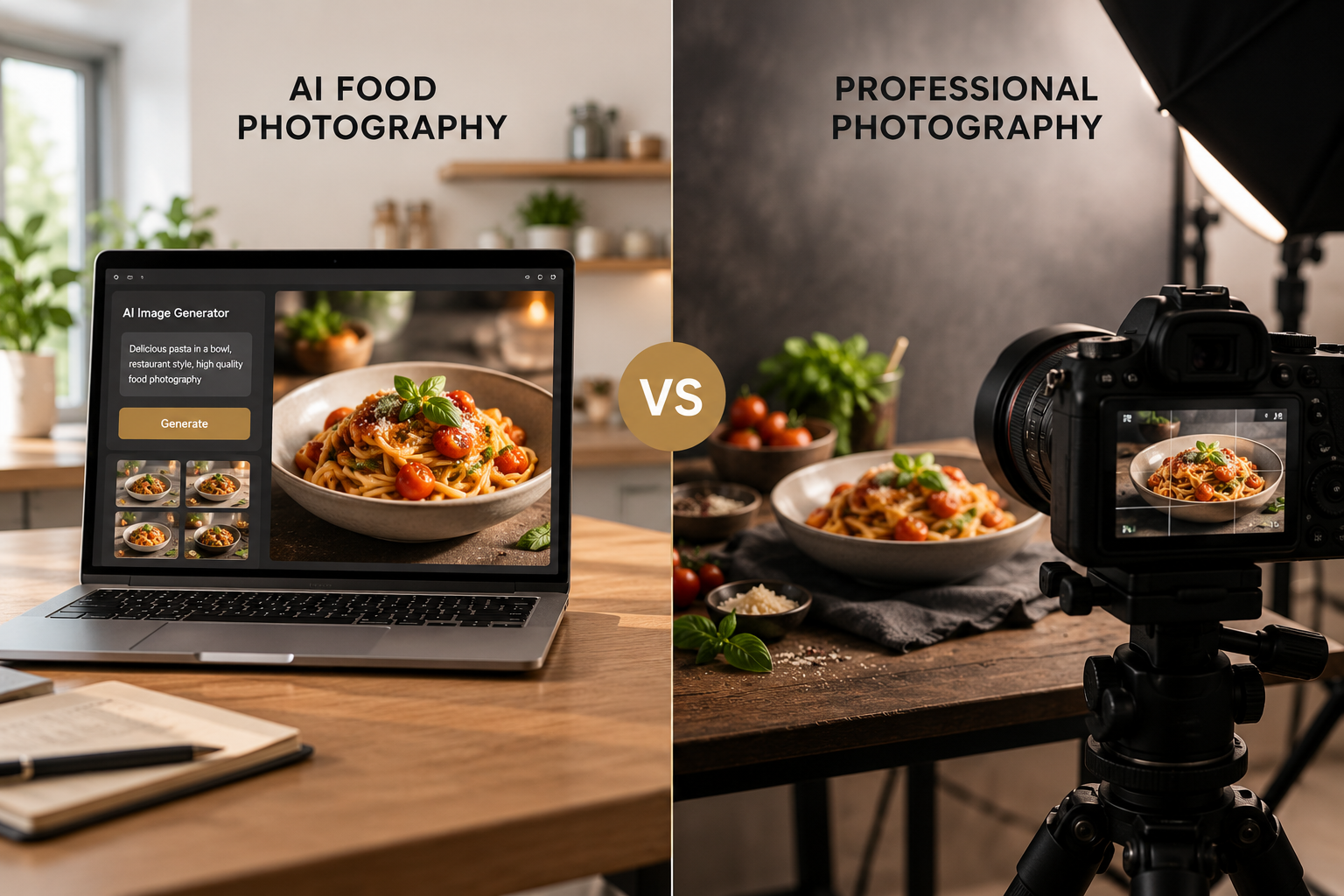
This gets framed as a competition, which is the wrong frame. The two approaches are good at different jobs, and a restaurant that understands the difference usually ends up using both.
The job most restaurants actually need done
Start with the honest requirement. A typical restaurant needs:
- An image for every dish on the menu — often forty or fifty of them.
- New images whenever a dish is added, which for many kitchens is monthly.
- Photos in several formats: menu, square for delivery apps, portrait for stories, landscape for the website.
- A steady flow of new images for the Google profile and social feed, indefinitely.
That is a volume-and-recurrence problem, not a craft problem. And it is precisely where conventional photography struggles: a shoot covers a point in time, costs a day of kitchen disruption plus a fee, and is out of date the next time the menu changes.
Where a professional shoot wins
There are jobs where nothing else will do, and it is worth being clear about them.
Brand photography. When you need a defining visual identity — a specific art direction, a particular mood, a look that belongs to your restaurant and nobody else — that is a creative direction problem, and it needs a photographer.
Atmosphere and people. The room at service, the team, guests at a table, the physical experience of being in your restaurant. This is not food photography and AI does not do it.
Flagship campaigns. A launch that will carry a large budget and be seen at scale deserves the control that only a shoot provides.
Unusual or highly technical presentation. Some plating genuinely needs an expert eye and controlled lighting to read properly at all.
Where AI food photography wins
Menu-wide coverage. Photographing forty dishes conventionally is a serious project. Doing it from phone photos taken across two services is an afternoon.
Turnaround. A new dish gets a usable image in the same week it launches. That single fact removes the most common reason promotions are delayed.
Consistency. This one is underrated. A menu photographed across six sessions in different light, at different angles, looks amateur even when each individual photo is fine. Working from a defined style produces a set that reads as one restaurant — which is difficult and expensive with shoots spread across months, and close to free here.
Delivery platform listings. On a delivery app the photo is the product page. Better images move a dish up the effective consideration list, and there are a lot of dishes.
Keeping the profile and feed supplied. Google rewards photo recency and guests read it as a sign of an active restaurant. A monthly cadence is achievable one way and not the other.
The line we hold
We work from photographs of dishes the restaurant actually serves. What changes is the lighting, the composition and the consistency — not the food.
This is not a technical limitation, it is a deliberate one. A guest who orders based on a picture should recognise what arrives on the plate. Generating an idealised dish that does not exist on your menu produces exactly one thing: a disappointed guest and, eventually, a review about it.
Cost, honestly
We are not going to publish a price comparison here, partly because photographer rates vary enormously and partly because the interesting number is not cost per image but cost per image per update cycle.
A shoot has a fixed cost each time it happens. If your menu is stable and you shoot once every two years, the per-image economics are reasonable. If your menu changes quarterly, you are either paying repeatedly or running with outdated photos — and most restaurants choose the second, which is why so many menus show dishes that left twelve months ago.
What most restaurants should actually do
The arrangement we see working best:
- One professional shoot, occasionally. For brand imagery, the room, the team and a handful of hero dishes. Once a year or once every two years.
- AI food photography for everything in between. The full menu, new dishes, delivery listings, seasonal items, and the monthly flow into Google and social.
That gives you the art direction where it matters and the coverage where it matters, and neither is doing the other one's job badly.
Getting started
If you want to see the difference on your own dishes before deciding anything, send a few phone photos and we will show you — see AI food photography for how the process works, or Plate Push Studio if you would rather produce visuals yourself.