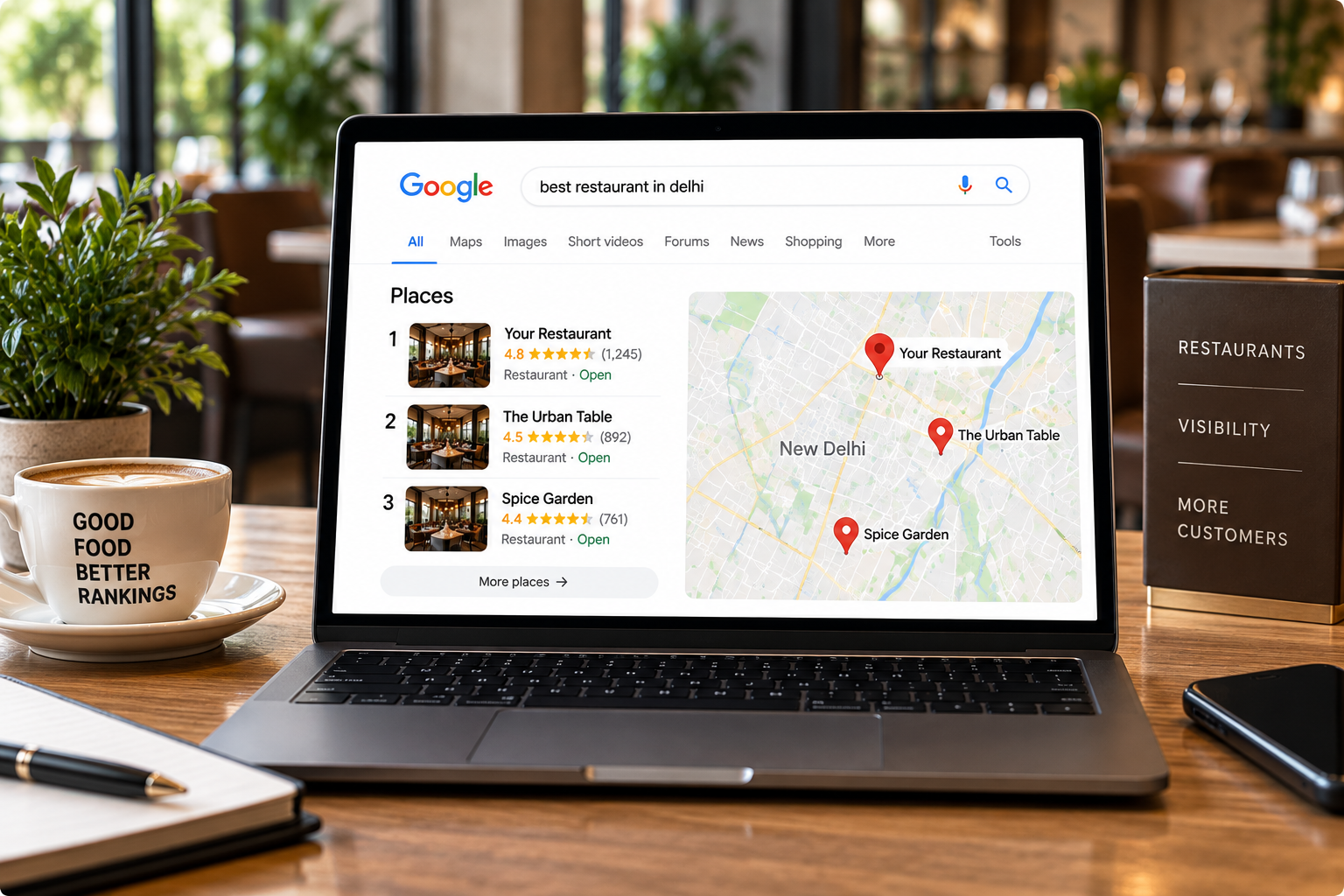
Restaurant search has three properties that break normal SEO thinking. It is hyper-local, so the same query returns different results two kilometres apart. It is time-sensitive, with "open now" and "delivery" modifiers that change the result set completely. And it is dominated by the map pack, which occupies the space above the classic organic results for almost every food query with local intent.
The practical consequence: roughly half of restaurant SEO is not on your website at all. Here is the order that works.
Step one: own the listing
Claim your Google Business Profile if you have not. If a former agency, a delivery platform or an unknown third party holds it, go through the reclaim process — it is tedious and it is not optional. While you are there, look for duplicate listings, which are common after a move or a rebrand and which split your reviews and your ranking signal in half.
Step two: get the primary category right
This is the single most consequential setting on the profile, and it is the one most often wrong. Google uses the primary category heavily to decide which searches you are eligible to appear in.
Choosing "Restaurant" to cover more ground does the opposite of what people expect. It makes you a weak match for everything rather than a strong match for something. If "Biryani restaurant", "Karak stall", "Neapolitan pizza restaurant" or "Cloud kitchen" describes you more precisely, use it. Secondary categories then extend your reach without diluting the primary signal.
In dense markets this matters enormously — see Google Business Profile management in Dubai for why category accuracy is decisive when forty restaurants share the same coordinates.
Step three: put the whole menu into Google's structured fields
A menu linked as a PDF or pointed at a delivery app contributes nothing to search. Google's structured menu fields are readable, searchable and displayed directly in results — and the dish names in them are exactly the terms people type.
Add every dish, with a description and a price. It takes an afternoon and it is the closest thing to free ranking improvement that exists for a restaurant.
Step four: fix the photo problem
Google surfaces recent photos prominently, and guests read them as evidence that the restaurant is currently operating well. A profile whose newest image is eighteen months old reads as closed even when the dining room is full.
The obstacle is almost always production rather than willingness. If arranging a shoot is not realistic — and for most restaurants it is not — AI food photography solves it: phone photos taken during prep, turned into a consistent set, added monthly.
Step five: build review volume and answer everything
Three things about reviews affect ranking: how many you have, how recent they are, and whether you respond. All three are within your control, and none of them involve buying anything.
Put a frictionless route in front of every guest — a QR code on the bill, a message after a delivery order — and answer every review that arrives, positive and negative, within a working day. What you must not do is offer an incentive or ask only the satisfied customers. Both breach platform policy and both risk your profile.
Step six: make the website crawlable
Now the site matters. The specific failures we see most often:
- A single-page site. Beautiful, and structurally invisible. There is nothing for a search engine to rank.
- The menu locked in a PDF. Your highest-value keywords, hidden.
- One page for every outlet. Branches cannot rank in their own areas, and they compete with each other.
- Slow mobile pages. Restaurant traffic is mobile, often on cellular data, often while moving.
The fix is a page per outlet, a real HTML menu, dish and cuisine pages where the volume justifies them, and Core Web Vitals that pass on a mid-range phone rather than on a desktop test. That is the substance of restaurant website development.
Step seven: structured data
Restaurant, Menu and LocalBusiness markup lets search engines read your cuisine, price range, hours and location without inferring them. It is not a ranking factor on its own, but it removes ambiguity, and ambiguity costs you eligibility for the results you want.
What you cannot fix
Proximity. Google weighs relevance, distance and prominence, and distance is not negotiable. You will not outrank a well-managed competitor two streets closer to the searcher, and no amount of content changes that.
What this means in practice is that you should measure your visibility as a radius rather than a rank. We check rankings across a grid of points around a restaurant, which shows exactly where visibility stops and which competitor holds the ground beyond it. A single rank number is close to meaningless for a restaurant — see local SEO for how that measurement drives the work.
A realistic timeline
Steps one to five can be completed in a few weeks and frequently produce visible movement inside two months, because the local competitive pool is small and most competitors have not done them. Steps six and seven take longer and compound over quarters.
If you want to know which of these apply to your restaurant specifically, the free audit checks all seven and hands you the findings.