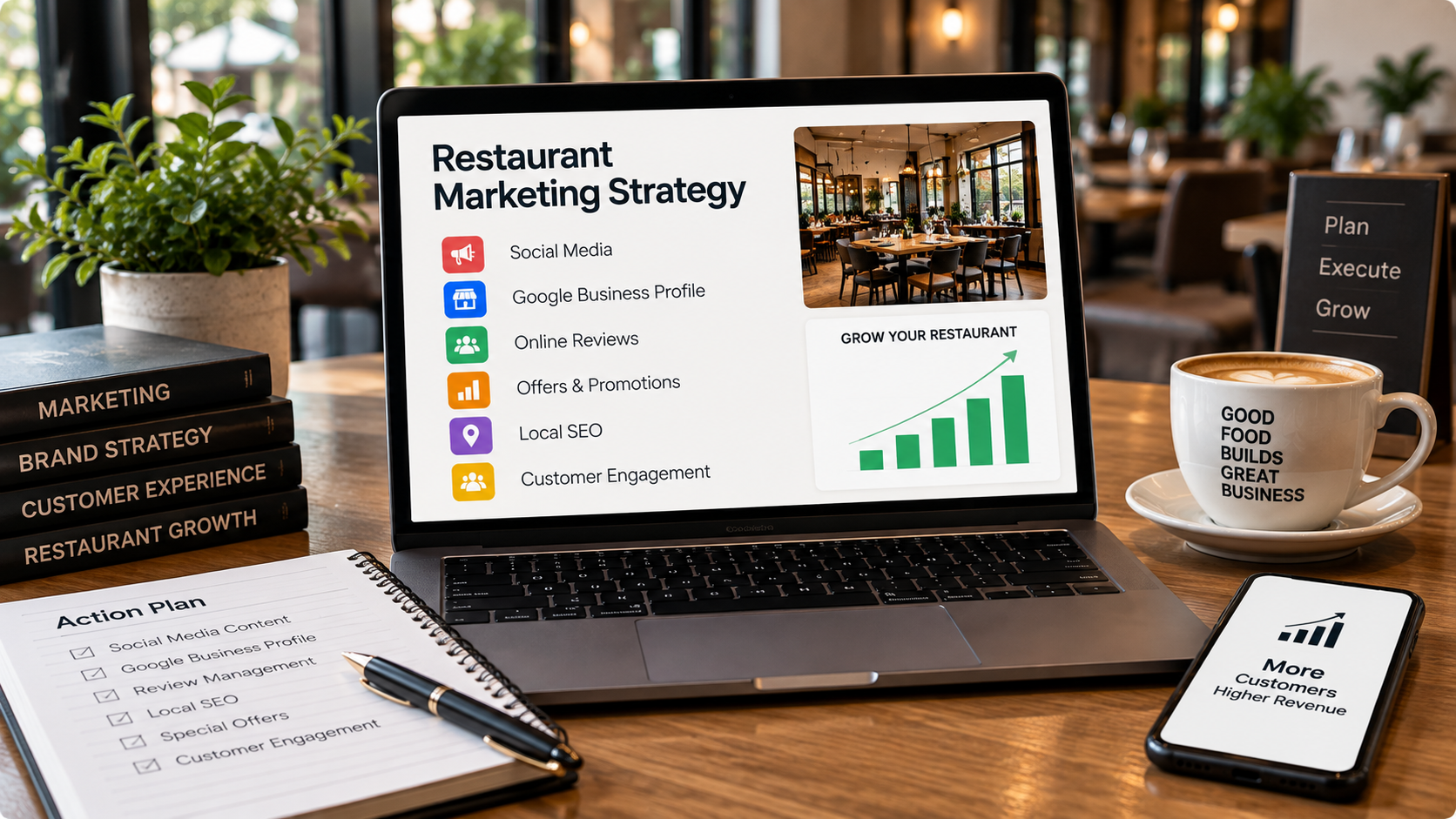
Dubai is the hardest restaurant market in the region to be noticed in, and the reason is simple arithmetic: the city has an extraordinary density of restaurants relative to its population, and a resident population that is used to choosing from dozens of options within a few minutes' drive. Marketing advice written for a market where you have four competitors does not survive here.
What follows is what we have found actually moves the needle in Dubai specifically, and — more usefully — what consistently does not.
The map pack is the whole game
For a restaurant in Dubai, the three map results that appear above the organic listings are worth more than everything below them combined. That is where a person deciding where to eat in the next twenty minutes looks, and it is the one place on the results page that the delivery aggregators cannot occupy.
This matters because of how the competition is structured. You will not outrank Talabat, Zomato or Deliveroo on organic search for "best burger Dubai" — their domain authority makes that a losing fight, and any agency promising it is either inexperienced or not being straight with you. But those platforms do not appear in the map pack. In that space you are competing against the restaurants physically near you, which is a fight you can win.
Three things decide map ranking, roughly in this order:
- Proximity. How close you are to the person searching. You cannot change this, but you can understand it — your realistic catchment is smaller than you think, and the marketing should target it rather than "Dubai".
- Relevance. Whether Google understands what you sell. This is category selection, menu data, dish names, attributes and the language in your reviews.
- Prominence. Review count, review recency, rating, reply rate and how active the profile is.
Relevance and prominence are entirely within your control, and in Dubai they are where the gap between competitors usually sits. Our local SEO and Google Business Profile management work is built around exactly those two levers.
Dubai's neighbourhoods behave like separate markets
One of the more expensive mistakes we see is treating Dubai as a single market with a single strategy. It is not. A Marina restaurant and a Karama restaurant are not competing with each other and should not be marketed the same way.
- Marina, JBR, Downtown, Business Bay, JLT, DIFC. Extremely high competition density, high delivery volume, a resident base that eats out frequently and decides quickly. Review volume and photo quality carry disproportionate weight because the shortlist is long and the decision is fast.
- Deira, Bur Dubai, Karama, Al Quoz. Strong value and authenticity-led demand, high repeat custom, lower competition for specific cuisine search terms. Being the clearly best-presented option for a specific dish is achievable here in a way it is not in Marina.
- Mirdif, Al Barsha, Al Nahda, Silicon Oasis, Arabian Ranches. Family and residential trade with genuine neighbourhood loyalty. Local search terms are cheaper, repeat visit rate is higher, and word of mouth still does real work.
The practical implication: your campaign radius, your opening-hours strategy, your offer timing and even your photography should follow the neighbourhood, not the city.
Review volume is the most underrated line item in Dubai
In a market this saturated, the rating is a filter and the review count is the tiebreaker. A guest comparing three nearby options at 8pm is not reading reviews carefully — they are glancing at "4.6 (1,240)" versus "4.7 (31)" and drawing a conclusion about reliability.
Most Dubai restaurants have a review problem that is really an asking problem. They have served tens of thousands of guests and collected a few hundred reviews, because nobody ever asked at the moment when asking works. The fix is operational rather than clever: a QR code at the point where the guest is happiest, a line on the receipt, a prompt in the delivery packaging, and staff who know the one sentence to say.
The second half is replying. Every review, including the good ones, ideally within a day or two. Reply rate is a signal Google reads and a signal guests read, and at the volume a busy Dubai restaurant generates it is genuinely unmanageable by hand — which is the problem our ReplyReviews platform was built to solve.
What to do about delivery platforms
Every Dubai restaurant operator has the same two-sided problem with aggregators: they deliver real volume, and they take 25–35% of it. The instinct to escape them entirely is understandable and usually wrong, because discovery has value and replacing it is harder than it looks.
The more profitable framing is to separate discovery from repeat business. Let the aggregators bring you new customers — that is what the commission is buying. Then move the people who have already ordered from you onto a channel you own: your own ordering page, or a branded ordering app for groups with the volume to justify one. You do not need to shift all of your delivery revenue for this to change the monthly picture; shifting the regulars is usually enough.
Paid advertising: useful, but second
Paid campaigns work well in Dubai, with two caveats.
The first is sequencing. Advertising sends people to a profile, a site or a menu. If the profile is poorly categorised, the photos are old and the reviews are unanswered, paid traffic converts badly and you are paying to discover that. Fix the destination before you buy traffic to it.
The second is timing. Restaurant demand is sharply time-bound — lunch, dinner, late night, weekends, and in Dubai, a markedly different rhythm during Ramadan. Campaigns that run flat across the day spend most of their budget when nobody is deciding. Google Ads captures people already searching; Meta Ads create demand with food visuals, which means the creative quality is the entire campaign.
The order we would spend in
- Google Business Profile, done properly. Categories, full menu with dish names, attributes, real photographs, weekly posts. It is free and it is the highest-return work available.
- A review programme. Asking systematically, replying to everything. Compounds over time and never stops paying.
- Photography that looks like the food. In a market where the decision is visual and fast, this is not decoration. AI food photography makes keeping it current affordable.
- A website that loads fast with a crawlable menu. Not a brochure — a menu search engines can read and a phone can open in two seconds.
- Paid campaigns. Once the first four are in place, so the traffic lands somewhere that converts.
- Owned repeat-order channel. When delivery volume is large enough that commission is a meaningful number.
Most restaurants we audit in Dubai are spending on item five while items one and two remain unaddressed. That is the single most common and most expensive mistake in this market.
Our Dubai restaurant marketing page covers how we work in the city specifically, and a free audit will tell you where you currently stand on each of the six points above.