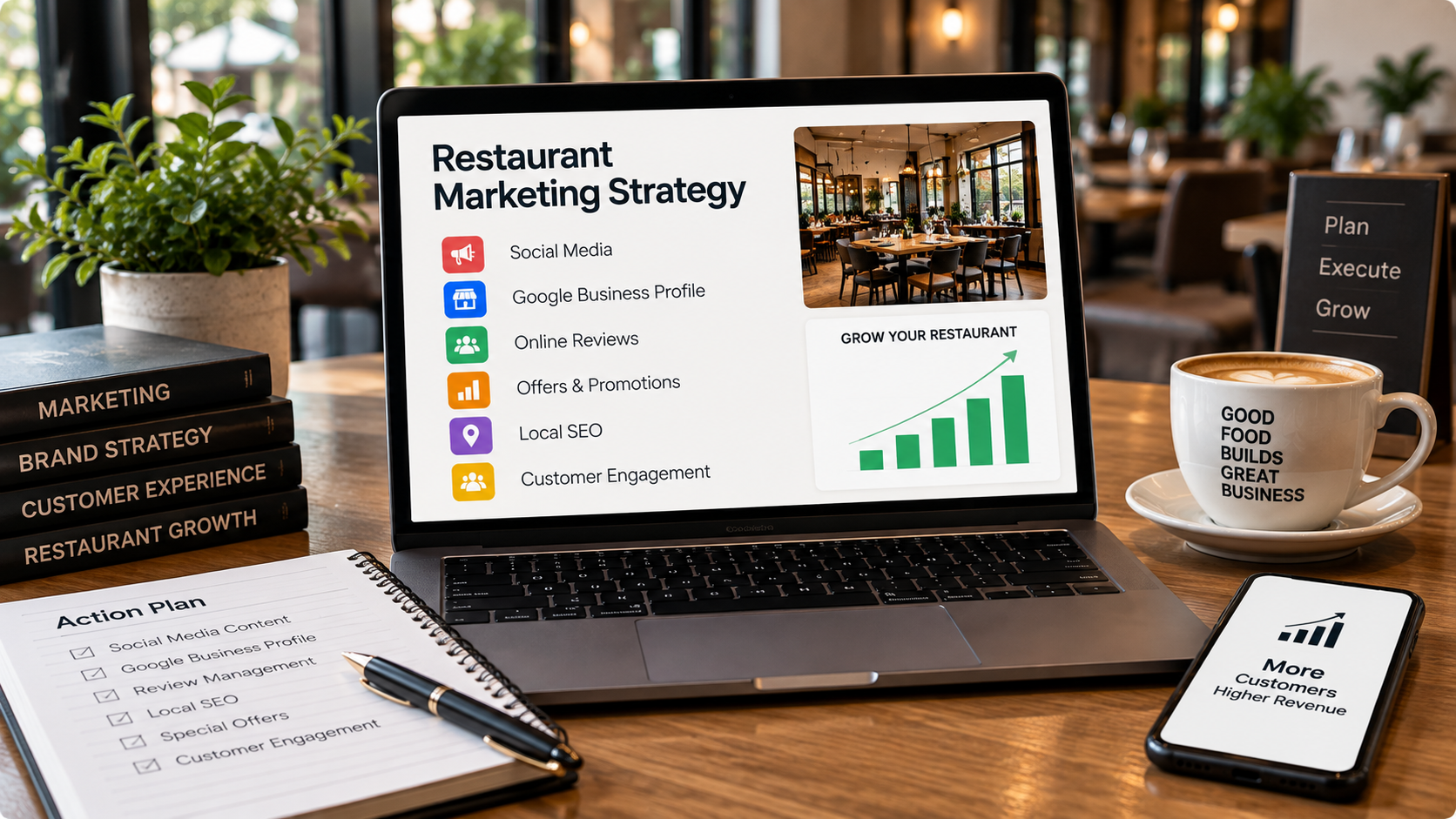
Ask ten restaurant owners about their marketing and you will hear ten versions of the same story. They started posting consistently, it went well for a few weeks, then a supplier problem and two staff resignations happened in the same fortnight and the account went quiet for two months. The plan was not wrong. It was just built for a business with spare capacity, which a restaurant does not have.
So the first principle of a restaurant marketing strategy is not a marketing principle at all. It is an operational one: anything that depends on someone finding a free hour will not happen. Build accordingly.
Start with what people see before they see anything else
For most restaurants, the first contact a potential guest has is not the website and not the Instagram account. It is the Google listing — the map result showing your name, your rating, three photos and whether you are open. That is your storefront, and it is where the strategy has to start.
Go and look at yours honestly. In our experience the same problems appear again and again:
- The primary category is "Restaurant" rather than the specific cuisine category that exists.
- The menu is not in Google's structured fields — it is a PDF link, or a link to a delivery app.
- The most recent photo is more than a year old, and half the photos were uploaded by customers.
- Dozens or hundreds of reviews have no reply.
- The hours were never corrected after the last Ramadan.
Each of these is both a ranking signal and a conversion signal, and fixing them costs nothing but attention. This is why Google Business Profile management is the first item on almost every plan we build, ahead of anything paid.
Know which searches you can actually win
Restaurant search splits into tiers. The head terms — "best restaurants in Dubai", "top brunch" — are owned by listicles, aggregators and publications with years of authority behind them. An individual restaurant is not going to displace them, and money spent trying is money gone.
The winnable searches are narrower. Your menu is a keyword list: "chicken mandi", "karak chai", "Kerala parotta", "wagyu burger". Add a neighbourhood and you have a query with real intent and, frequently, almost no optimised competition. Someone searching "mandi Al Nahda" is minutes from ordering. Someone searching "best restaurants Dubai" is reading.
This is the substance of restaurant SEO, and it is worth being precise about it early, because it determines what content you produce for the next year.
Decide what content you can genuinely sustain
The honest question is not "how often should we post" but "how often can we post in a bad month". Three strong posts a week that survive a difficult period beat daily posting that collapses after five weeks, and the collapse is more visible than the frequency ever was.
The way to raise that sustainable floor is to remove production friction rather than to try harder:
- Batch the production. A month of content planned, produced and approved in one pass, then scheduled. One approval instead of twenty small requests.
- Solve the photography problem structurally. Most restaurants have no visuals because a shoot is expensive and disruptive. AI food photography turns a phone photo taken during prep into something usable, which changes the maths entirely.
- Build a template system. If every offer graphic starts from a blank canvas, offers will keep launching late. A brand system means producing a creative is a task, not a project.
Treat reviews as a system, not as a chore
Your rating filters people before they read a word about you. The difference between 4.6 and 4.1 is a large share of the guests who will never visit, and they decide in about two seconds.
Two things matter, and they are different. Volume and recency dilute the impact of any single bad night — a restaurant with a steady flow of new reviews is far more resilient than one with two hundred reviews from 2023. Reply rate affects both ranking and how the listing reads to a browsing guest.
Neither happens by intention. They happen by having a route for guests to leave a review (a QR on the bill, a message after a delivery order) and a defined workflow for answering. What you cannot do is offer anything in exchange for a review or ask only the happy customers — both violate platform policy and risk the profile. Reputation management covers the mechanics.
Add paid only when it has somewhere to send people
Paid campaigns are the fastest way to produce demand and the fastest way to waste a budget. Two rules keep them honest.
First, fix the destination before increasing the spend. If your menu is a PDF, your phone number is not tappable and the page takes six seconds on mobile, every click you buy is thrown away on arrival.
Second, respect the geography and the clock. A restaurant serves a radius, not a country, and demand spikes before lunch, before dinner, and hard on Thursday and Friday evenings. Default settings in both Google Ads and Meta are considerably broader than most owners assume.
Automate the parts that must never stop
This is where the operational principle at the top comes back. Review replies, weekly Google Posts, scheduled social content, hour updates at Ramadan, monthly reporting — these are small, repetitive and endless, and they are the first things dropped when service gets hard.
Marketing automation is not a luxury layer on top of a strategy for a restaurant. It is what makes the strategy survive contact with a difficult month. Routine work runs automatically; anything sensitive — a serious complaint, an allegation about hygiene — escalates to a person before anything is published.
A realistic order of operations
- Weeks 1–2. Claim and fully rebuild the Google Business Profile. Categories, menu, attributes, hours, a real photo set.
- Weeks 2–4. Clear the review backlog. Answer everything. Put a route in place for new reviews.
- Weeks 3–6. Fix the website basics — mobile speed, crawlable menu, tappable phone number, one page per outlet.
- Month 2 onwards. Establish the content rhythm: monthly batch, scheduled, published across social and Google.
- Month 3 onwards. Layer on SEO content and paid campaigns, with reporting against calls, direction requests and enquiries.
Almost every restaurant that comes to us wanting to start at step five would get more from step one. That is not a sales position — step one is the cheapest thing on the list.
Measure the things that turn into service
Impressions and follower counts tell you almost nothing about a restaurant. Calls, direction requests, menu views, online orders and enquiries tell you a great deal. Track those, per channel, and judge the plan on them.
If you want a starting point specific to your restaurant rather than a general one, the free audit is exactly this exercise run on your business — and you keep the findings regardless of what happens next.